Representation World Modeling
We demonstrate the value of explicitly predicting future visual representations for 3D object flow generation, and introduce MotionRep to jointly model future DINO representations and object motion.
TL;DR: MotionRep jointly generates future DINO representations and 3D object flow within a unified diffusion transformer, modeling future states in a semantically and geometrically rich representation space rather than a pixel-reconstruction-oriented latent space to achieve accurate 3D object flow generation and strong generalization to unseen scenes with only three denoising steps.
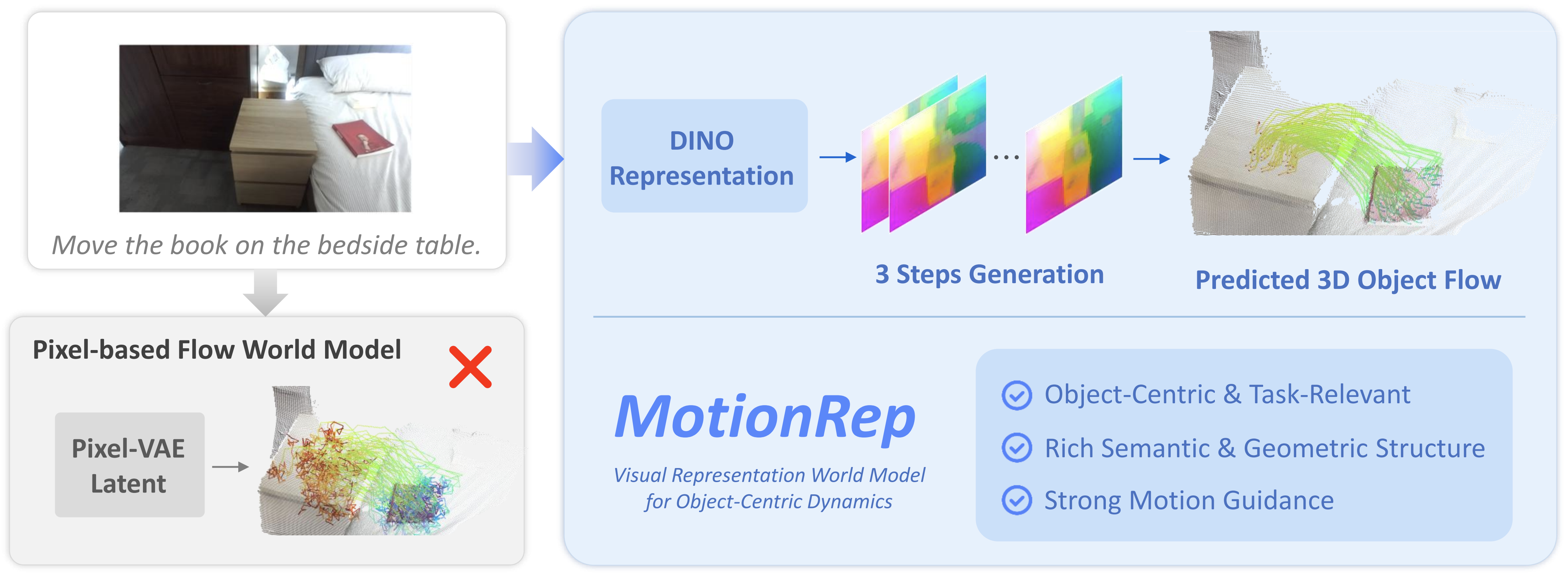
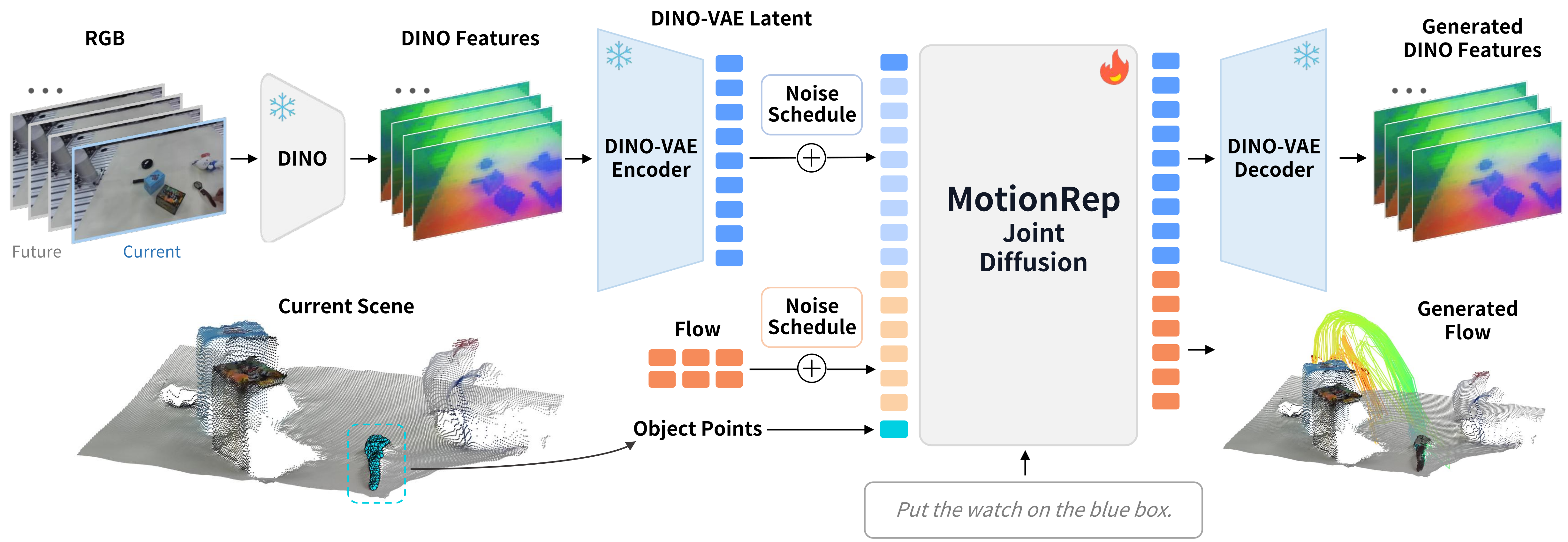
Many embodied world models predict future states in latent spaces optimized for RGB reconstruction, which do not explicitly prioritize object-level semantics and geometry relevant to motion generation. We present MotionRep, a visual representation world model that jointly generates future DINO representations and 3D object flow, coupling semantic and geometric information with object-centric dynamics. To make high-dimensional DINO features amenable to generative modeling, we introduce DINO-VAE, which combines temporal and channel compression with latent regularization to produce compact latents while preserving semantic and geometric information. Conditioned on an initial observation, object query points, and a language instruction, a unified diffusion transformer predicts future visual representations and 3D object flow through joint attention. MotionRep employs asymmetric modality-specific noise schedules to keep the visual stream ahead of 3D object flow during joint denoising, allowing progressively refined future visual representations to guide flow generation. Experiments on simulated and real-world manipulation benchmarks demonstrate that MotionRep outperforms pixel-based baselines in 3D object flow accuracy and generalization to unseen scenes, while requiring only three denoising steps for inference. These results support predictive visual representations as an effective future-state space for object-centric dynamics modeling.
We demonstrate the value of explicitly predicting future visual representations for 3D object flow generation, and introduce MotionRep to jointly model future DINO representations and object motion.
DINO-VAE makes dense DINO features amenable to generative modeling through temporal and channel compression with latent regularization, preserving semantic and geometric information.
Decoupled timestep sampling and modality-specific noise schedules enable representation-guided flow generation and bidirectional conditional dynamics modeling within the same model.
We visualize 3D object flow generated by MotionRep within reconstructed 3D scenes, showing 64 predicted point trajectories overlaid on the initial scene point cloud. Across diverse manipulation tasks, MotionRep produces coherent trajectories that capture motion directions, spatial displacements, and goal-directed movements while maintaining consistency with the surrounding scene geometry.
We present qualitative results of MotionRep across diverse real-world and simulated scenarios, including joint generation of future DINO representations and 3D object flow, as well as downstream RGB reconstruction, depth estimation, and semantic segmentation.
MotionRep jointly generates future DINO representations and 3D object flow across diverse manipulation tasks. The top row compares ground-truth and predicted 3D object trajectories projected onto the initial RGB frame and colored by time. The bottom row compares ground-truth and generated future DINO representations visualized using a shared PCA basis. The results illustrate consistency between predicted object motion and future scene evolution.
3D Object Flow
Future DINO Representation
3D Object Flow
Future DINO Representation
3D Object Flow
Future DINO Representation
3D Object Flow
Future DINO Representation
3D Object Flow
Future DINO Representation
3D Object Flow
Future DINO Representation
3D Object Flow
Future DINO Representation
3D Object Flow
Future DINO Representation
3D Object Flow
Future DINO Representation
3D Object Flow
Future DINO Representation
3D Object Flow
Future DINO Representation
3D Object Flow
Future DINO Representation
3D Object Flow
Future DINO Representation
3D Object Flow
Future DINO Representation
3D Object Flow
Future DINO Representation
3D Object Flow
Future DINO Representation
3D Object Flow
Future DINO Representation
3D Object Flow
Future DINO Representation
3D Object Flow
Future DINO Representation
3D Object Flow
Future DINO Representation
3D Object Flow
Future DINO Representation
3D Object Flow
Future DINO Representation
3D Object Flow
Future DINO Representation
3D Object Flow
Future DINO Representation
3D Object Flow
Future DINO Representation
3D Object Flow
Future DINO Representation
3D Object Flow
Future DINO Representation
3D Object Flow
Future DINO Representation
3D Object Flow
Future DINO Representation
3D Object Flow
Future DINO Representation
3D Object Flow
Future DINO Representation
3D Object Flow
Future DINO Representation
3D Object Flow
Future DINO Representation
3D Object Flow
Future DINO Representation
3D Object Flow
Future DINO Representation
3D Object Flow
Future DINO Representation
3D Object Flow
Future DINO Representation
3D Object Flow
Future DINO Representation
3D Object Flow
Future DINO Representation
3D Object Flow
Future DINO Representation
3D Object Flow
Future DINO Representation
3D Object Flow
Future DINO Representation
3D Object Flow
Future DINO Representation
3D Object Flow
Future DINO Representation
3D Object Flow
Future DINO Representation
3D Object Flow
Future DINO Representation
3D Object Flow
Future DINO Representation
3D Object Flow
Future DINO Representation
3D Object Flow
Future DINO Representation
3D Object Flow
Future DINO Representation
3D Object Flow
Future DINO Representation
3D Object Flow
Future DINO Representation
3D Object Flow
Future DINO Representation
3D Object Flow
Future DINO Representation
3D Object Flow
Future DINO Representation
3D Object Flow
Future DINO Representation
3D Object Flow
Future DINO Representation
3D Object Flow
Future DINO Representation
3D Object Flow
Future DINO Representation
3D Object Flow
Future DINO Representation
We use a lightweight RGB decoder to visualize ground-truth and MotionRep-generated future DINO representations as RGB videos, alongside original ground-truth RGB videos. The overlaid ground-truth (green) and predicted (red) 3D object flow trajectories illustrate the consistency between generated visual states and object motion.
We apply a lightweight frozen depth decoder with fewer than 1M parameters to ground-truth and generated future DINO representations. The resulting depth maps illustrate MotionRep's ability to capture scene geometry and spatial changes during object manipulation. Both depth predictions use the same decoder and color scale within each example, with blue indicating near regions and red indicating far regions.
We apply a lightweight frozen segmentation decoder with fewer than 1M parameters to ground-truth and generated future DINO representations to predict five semantic classes: background, table, robot, clutter, and manipulated object. The segmentation results illustrate the preservation of object-level semantics and spatial structures throughout scene evolution.
We evaluate 3D object flow generation on WorldFlowBench, comprising 1,678 manipulation clips across three groups: Sim7 (396), Real3 (882), and SpatialCog (400). Given an initial RGB observation, a language instruction, and 64 object query points, each method predicts 3D object trajectories over a 49-frame sequence. MotionRep consistently achieves the best ADE, FDE, and PWT across all three groups, outperforming advanced baselines.
396 clips from seven simulation suites, with metric ground-truth trajectories. Bold indicates the best result; underlining indicates the second-best.
| Method | Type | ADE | FDE | PWT |
|---|---|---|---|---|
| NovaFlow | Video + tracker | 0.1964 | 0.3186 | 0.2897 |
| Cosmos3-Nano + Track4World | Video + tracker | 0.1008 | 0.2021 | 0.4510 |
| Cosmos3-Nano + 4RC | Video + tracker | 0.0963 | 0.1958 | 0.5308 |
| LingBot-Video-MoE + Track4World | Video + tracker | 0.1051 | 0.2072 | 0.4247 |
| LingBot-Video-MoE + 4RC | Video + tracker | 0.1035 | 0.2072 | 0.4919 |
| MolmoMotion-AR (H1) | Direct flow | 0.1796 | 0.3297 | 0.2940 |
| μ0 | Direct flow | 0.1868 | 0.3073 | 0.0698 |
| EgoWAM | Direct flow | 0.1987 | 0.3365 | 0.0209 |
| WorldFlow | Video + flow | 0.0510 (second best) | 0.0940 (second best) | 0.5640 (second best) |
| MotionRep (Ours) | DINO + flow | 0.0447 (best) | 0.0768 (best) | 0.5965 (best) |
882 clips from three real-world sources, with metric scale estimated from monocular video. Bold indicates the best result; underlining indicates the second-best.
| Method | Type | ADE | FDE | PWT |
|---|---|---|---|---|
| NovaFlow | Video + tracker | 0.0959 | 0.1290 | 0.2930 |
| Cosmos3-Nano + Track4World | Video + tracker | 0.0881 | 0.1333 | 0.3095 |
| Cosmos3-Nano + 4RC | Video + tracker | 0.0847 | 0.1219 | 0.3318 (second best) |
| LingBot-Video-MoE + Track4World | Video + tracker | 0.0967 | 0.1453 | 0.2670 |
| LingBot-Video-MoE + 4RC | Video + tracker | 0.0924 | 0.1344 | 0.2951 |
| MolmoMotion-AR (H1) | Direct flow | 0.1818 | 0.3308 | 0.2501 |
| μ0 | Direct flow | 0.1164 | 0.1564 | 0.1480 |
| EgoWAM | Direct flow | 0.1301 | 0.1901 | 0.0562 |
| WorldFlow | Video + flow | 0.0810 (second best) | 0.1130 (second best) | 0.3110 |
| MotionRep (Ours) | DINO + flow | 0.0657 (best) | 0.0892 (best) | 0.3521 (best) |
400 real-world clips with calibrated camera intrinsics. Bold indicates the best result; underlining indicates the second-best.
| Method | Type | ADE | FDE | PWT |
|---|---|---|---|---|
| NovaFlow | Video + tracker | 0.1657 | 0.2951 | 0.3200 |
| Cosmos3-Nano + Track4World | Video + tracker | 0.1409 | 0.2571 | 0.3978 |
| Cosmos3-Nano + 4RC | Video + tracker | 0.1412 | 0.2632 | 0.4012 |
| LingBot-Video-MoE + Track4World | Video + tracker | 0.1338 | 0.2387 | 0.3644 |
| LingBot-Video-MoE + 4RC | Video + tracker | 0.1311 | 0.2321 | 0.3755 |
| MolmoMotion-AR (H1) | Direct flow | 0.2762 | 0.5331 | 0.1903 |
| μ0 | Direct flow | 0.2132 | 0.2705 | 0.0553 |
| EgoWAM | Direct flow | 0.2493 | 0.3838 | 0.0800 |
| WorldFlow | Video + flow | 0.0600 (second best) | 0.0780 (second best) | 0.4490 (second best) |
| MotionRep (Ours) | DINO + flow | 0.0567 (best) | 0.0743 (best) | 0.4503 (best) |
ADE measures mean point displacement error over time, while FDE measures error at the final frame (both in meters; lower is better). PWT is the fraction of point-frame predictions within 1, 2, and 5 cm of ground truth, averaged across the three thresholds (higher is better). Scores are computed per clip over a 49-frame sequence and macro-averaged within each group. All methods use one conditioning RGB frame, the task description, and the query points.
We further analyze the generalization, inference efficiency, and representation quality of MotionRep, validate its key design choices, and demonstrate its bidirectional dynamics inference capabilities.
We evaluate MotionRep on RoboMIND 2.0, a dataset entirely excluded from training. MotionRep consistently outperforms competing methods across all three metrics, demonstrating strong generalization to unseen manipulation scenes and tasks. Bold indicates the best result; underlining indicates the second-best.
| Method | ADE | FDE | PWT |
|---|---|---|---|
| NovaFlow | 0.1171 (second best) | 0.2401 | 0.4981 (second best) |
| MolmoMotion-AR (H1) | 0.1986 | 0.3054 | 0.1335 |
| μ0 | 0.1639 | 0.2125 (second best) | 0.1184 |
| WorldFlow | 0.1346 | 0.2229 | 0.3851 |
| MotionRep (Ours) | 0.0612 (best) | 0.0980 (best) | 0.5257 (best) |
MotionRep generates 48 future frames of 3D object flow in just 2.21 seconds with three denoising steps, achieving approximately 6× and 83× speedups over WorldFlow and MolmoMotion-AR, respectively. All inference measurements are conducted under identical hardware conditions.
| Method | Steps | Latency (s) |
|---|---|---|
| NovaFlow | 44 | 78.44 |
| Cosmos3-Nano + Track4World | 41 | 8.19 |
| Cosmos3-Nano + 4RC | 41 | 8.15 |
| LingBot-Video-MoE + Track4World | 40 | 40.47 |
| LingBot-Video-MoE + 4RC | 40 | 40.42 |
| MolmoMotion-AR (H1) | 40 | 183.91 |
| WorldFlow | 40 | 13.90 |
| MotionRep (Ours) | 3 (best) | 2.21 (best) |
DINO-VAE produces compact generative latents while preserving rich semantic and geometric information. We evaluate its representation quality through semantic probing, geometric probing, and reconstruction-based downstream tasks.

Semantic structure of the latent space. Following the DINOv3 protocol, we train a linear probe on UCF101 for action classification. DINO-VAE latents achieve substantially higher classification accuracy than pixel-reconstruction-oriented video VAE latents, demonstrating their ability to preserve high-level semantics under strong compression.
| Representation | Single | TTA |
|---|---|---|
| DINOv3-L | 92.84 | 93.26 |
| DINO-VAE reconstruction (ours) | 90.51 | 91.07 |
| CogVideoX VAE | 14.51 | 14.14 |
| Wan2.2 VAE | 16.94 | 16.29 |
| AToken | 30.83 | 30.29 |
| DINO-VAE latent (ours) | 79.17 | 81.79 |
Geometric information in the latent space. We independently train lightweight depth decoders on original DINOv3-L features and compressed DINO-VAE latents. Despite substantial temporal and channel compression, DINO-VAE latents retain geometric information comparable to the original DINO features.
| Representation | AbsRel | RMSE (m) | δ1 |
|---|---|---|---|
| DINOv3-L | 0.0423 | 0.1422 | 0.9705 |
| DINO-VAE latent (ours) | 0.0426 | 0.1432 | 0.9668 |
Reconstruction quality. We evaluate reconstruction quality through feature similarity and downstream depth estimation and semantic segmentation using frozen decoders. DINO-VAE achieves performance close to the original DINO features and consistently outperforms PCA under the same compression budget.
| Features | Cos | MSE | AbsRel | RMSE (m) | δ1 | mIoU | IoUTarget |
|---|---|---|---|---|---|---|---|
| DINOv3-L | 1.0000 | 0.0000 | 0.0471 | 0.0987 | 0.9777 | 0.9204 | 0.6977 |
| PCA (matched budget) | 0.8513 | 0.3973 | 0.1714 | 0.2410 | 0.6873 | 0.8753 | 0.5471 |
| DINO-VAE (ours) | 0.9640 | 0.1013 | 0.0556 | 0.1086 | 0.9721 | 0.9097 | 0.6593 |
We ablate four key design choices of MotionRep on RoboTwin: DINO-VAE, future DINO generation, modality-specific noise scheduling, and visual representation world model pretraining. All ablations degrade 3D object flow generation performance, validating their complementary contributions.
| Method | ADE | FDE | PWT |
|---|---|---|---|
| MotionRep w/o DINO-VAE | 0.0727 | 0.1937 | 0.5490 |
| MotionRep w/o pretrain | 0.0597 | 0.1496 | 0.5500 |
| MotionRep w/o DINO generation | 0.0517 | 0.1147 | 0.5483 |
| MotionRep w/ shared schedule | 0.0477 | 0.1072 | 0.5440 |
| MotionRep (full) | 0.0315 (best) | 0.0738 (best) | 0.6670 (best) |
Beyond joint generation, MotionRep supports bidirectional conditional dynamics inference within a unified model. Under visual-conditioned inverse dynamics, MotionRep generates 3D object flow conditioned on clean future DINO representations, outperforming Track4World on Sim7. Under flow-conditioned forward dynamics, MotionRep generates future DINO representations conditioned on clean 3D object flow, modeling scene evolution under specified object motion.
| Method | ADE | FDE | PWT |
|---|---|---|---|
| Track4World | 0.1079 | 0.1726 | 0.4636 |
| MotionRep-IDM (ours) | 0.0370 (best) | 0.0849 (best) | 0.6220 (best) |